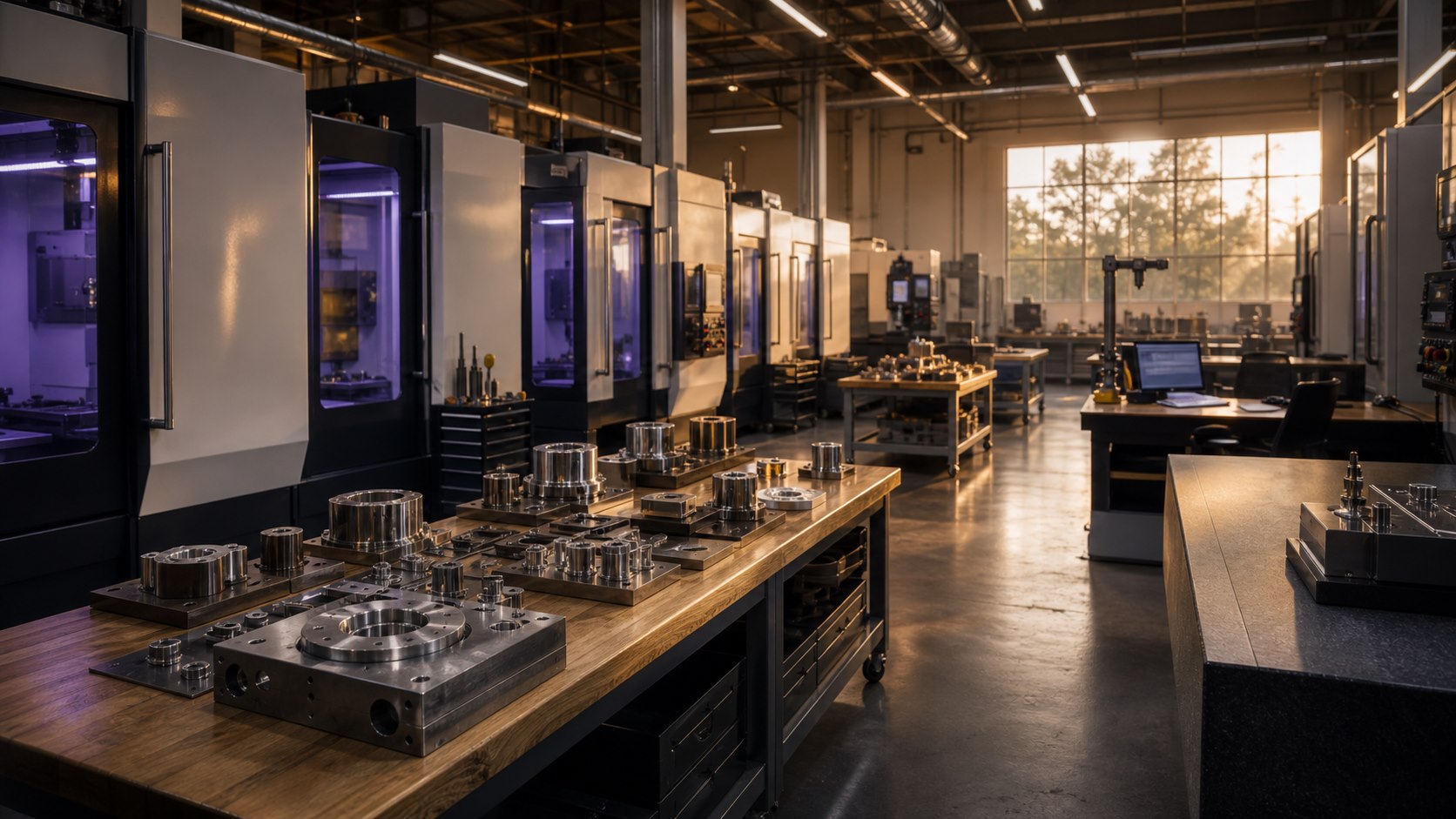
AI automation is moving into manufacturing from two directions at once. On the production side, robotics, sensors, simulation, digital twins, and software-defined equipment keep improving. On the office side, AI can now summarize RFQs, compare documents, draft follow-up, organize quote notes, and help teams find answers buried in shared drives, ERP exports, quality files, and email.
For a Los Angeles manufacturer, the risk is not that AI is useless. The risk is buying a tool before the company has a workflow and data standard ready for it. A shop can spend money on a platform and still have the same bottlenecks: missing RFQ details, unclear file names, quote follow-up stuck in one inbox, supplier packets rebuilt from scratch, and production notes that only one person knows how to find.
The useful question is not "Which AI tool should we buy?" It is "Which repeated workflow can we make cleaner, safer, and easier to review this month?" That question helps small and midsize manufacturers in Vernon, Commerce, City of Industry, Long Beach, the South Bay, and the San Fernando Valley start with a real business problem instead of a software demo.
Why automation readiness matters now
Manufacturing AI coverage is shifting away from vague promise and toward implementation discipline. Manufacturing Dive's September 2026 IMTS reporting describes automation and AI as major manufacturing trends, with labor constraints pushing companies to look harder at automation. That does not mean a small or midsize manufacturer should buy the biggest platform first. It means the workflow feeding that platform has to be clean enough to trust.
That matters for LA manufacturers because many shops are not starting from a clean digital foundation. The buyer sends a PDF, a STEP file, a spreadsheet, and a note buried in an email thread. The estimator knows which detail matters, but the information sits across too many places. The first AI project should make that workflow easier to prepare and review.
NIST's 2026 roadmap for AI and machine learning in smart manufacturing points to the same operating reality: industrial data, data management, integration, trustworthiness, explainability, reliability, safety, digital twins, large language models, and foundation models all affect whether AI can work inside a real production environment. These are not abstract research topics for a Los Angeles shop. They decide whether AI can safely support RFQ intake, quote preparation, customer updates, or document search.
Use the 2026 roadmap as a buying filter
The NIST roadmap is useful because it turns a software question into a readiness checklist. A manufacturer can ask whether the tool improves industrial data quality, whether it connects to the right source systems, whether the output is explainable enough for a reviewer, whether reliability can be measured, and whether safety or privacy rules are clear before the tool touches sensitive files.
That filter keeps the first sprint practical. If the team cannot name the source material, owner, output, review rule, and metric for one workflow, the company is not ready for a larger automation project. If it can name those pieces, AI training, business process automation, ERP cleanup, and later robotics or digital twin work become easier to evaluate.
Standardize the data before automation
Data standardization does not have to start as a giant ERP project. For a small or midsize manufacturer, the first pass is usually practical: use the same RFQ fields, quote-folder structure, file naming rules, buyer status labels, supplier packet facts, approved capability language, and review ownership across the team.
Start with the workflow closest to revenue. If RFQ intake is the bottleneck, standardize project type, material, quantity, drawing status, due date, buyer role, location, missing information, estimator owner, and follow-up date. If quote follow-up is the bottleneck, standardize open-quote status, last touch, next action, buyer question, approved message language, and close/lost reason.
Those simple standards make AI safer because the model is no longer guessing from a pile of inconsistent notes. They also make automation easier to measure: fewer missing fields, faster estimator handoffs, cleaner customer updates, and better document-search answers.
Start with one workflow, not a platform
A good first workflow has five traits. It repeats every week. It has clear source material. It creates a reviewable output. It sits close to revenue or delivery risk. It can be measured without a six-month project.
For many manufacturers, the best first candidates are RFQ intake, quote-prep notes, quote follow-up, supplier packet preparation, customer status updates, and document search. These tasks are not glamorous, but they are where deals slow down and customers lose confidence. They also give AI useful constraints: read these files, summarize these fields, list missing information, draft this follow-up, and stop before pricing or technical commitments.
If the first workflow is unclear, start with AI consulting for manufacturing companies in Los Angeles. If the workflow is clear but the team needs shared habits, move into AI training for manufacturers in Los Angeles. If the task repeats every week and the owner is known, connect it to business process automation for manufacturers. If the team is comparing outside admin support with software, use the guide to BPO for manufacturing companies before assigning quote follow-up or RFQ cleanup to a vendor or AI workflow.
Clean the RFQ and quote path first
RFQ intake is a strong readiness test because it reveals how the company handles source material. Where do drawings go? Who checks whether a file is current? What fields must be captured before estimating begins? What information is safe for an AI tool to summarize? Who approves the customer-facing response?
AI can help prepare the quote path. It can identify attachments, summarize buyer requirements, extract quantities, list missing information, draft a clarification email, and create an internal brief for the estimator or owner. It should not approve pricing, lead time, tolerances, substitutions, compliance language, or customer commitments.
A readiness pass turns that boundary into a workflow. The AI output should show what it used, what it did not know, what still needs review, and who owns the next action. That is the difference between useful automation and a risky shortcut.
Make document search safe before it gets powerful
Many manufacturers already have the answers they need. The problem is that those answers are scattered across old quotes, quality documents, customer emails, vendor notes, drawing folders, photos, ERP exports, spreadsheets, and the memory of one or two experienced people.
Document search can help, but only after the company sets rules. Which folders can be indexed? Which files include customer secrets, pricing, drawings, or supplier terms? Which answers need a quality lead, estimator, owner, or production manager to approve? Which tool is allowed to touch which data?
For Los Angeles machine shops and fabricators, the first document-search sprint often starts with approved public and internal knowledge: capability statements, standard quote language, common buyer questions, setup checklists, inspection note formats, and status update templates. More sensitive records can be added later when permissions and review rules are mature.
Do not sell automation as labor savings only
Automation projects stall when the only business case is "save admin time." That may be true, but it is rarely enough. Manufacturing leaders usually care more about quote speed, fewer missed details, cleaner customer updates, less rework, faster answers, better quality documentation, and lower risk in handoffs. Manufacturing Dive's September automation coverage also makes the labor context plain: companies are looking at automation because capacity is tight, not because process design stopped mattering.
That is why the first measurement should be operational. Track time to prepare a quote brief. Track how often missing information is caught before quoting. Track whether open-quote follow-up happens on schedule. Track how long it takes to find an approved document. Track how many customer updates need rewriting because the source facts were unclear.
When the workflow improves those metrics, the company has a better reason to expand. It can then consider stronger automation, integrations, robotics workflows, digital twin planning, or AI agents with less guesswork.
Train the team before scaling tools
AI automation breaks when one person experiments alone and the rest of the company keeps working the old way. A manufacturer needs shared rules: what AI can prepare, what it cannot decide, where files live, how outputs are reviewed, how private information is handled, and what to do when an answer is weak.
Training should use real work. A generic AI class may teach the tool, but it will not teach the company's RFQ path, quote language, buyer categories, production constraints, and review boundaries. The first session should include the owner or general manager plus the people who own the selected workflow: estimator, sales lead, office manager, production coordinator, quality lead, or customer service person.
The deliverable should be an operating kit, not a lecture. The team should leave with a workflow name, source-material list, prompt or instruction set, output format, review checklist, file policy, owner, and first-month metric.
Connect automation readiness to buyer visibility
Manufacturing automation work can also support search visibility. The same approved facts that make RFQ intake and supplier packets easier can strengthen website content: capabilities, materials, service area, industries served, quality process, lead-time questions, quoting requirements, and what buyers should send before asking for a quote.
This matters for AI SEO because search engines and AI answer systems need clear, specific, public language. It also supports B2B outreach for manufacturers because sales conversations can point prospects to useful process pages instead of thin marketing copy.
Google's official AI optimization guidance still points companies back to useful, people-first, non-commodity content. For a manufacturer, that means turning real operating clarity into useful public explanations instead of publishing recycled AI trend copy. Use approved public knowledge, not private customer work. Do not invent client names, case studies, reviews, certifications, capacity claims, or local address details.
Automation readiness checklist
- Choose one repeated workflow: RFQ intake, quote prep, follow-up, supplier packets, customer updates, or document search.
- Define the trigger, source material, owner, output, review rule, and next action.
- Set file rules for drawings, customer emails, quote folders, ERP or CRM exports, supplier documents, and quality records.
- Decide what information is allowed in each AI tool and what must stay out.
- Keep price, lead time, tolerances, compliance language, and customer commitments under human approval.
- Train the people who own the workflow with real company examples.
- Track one useful metric for 30 days before expanding the tool stack.
Sources and current context
This readiness approach is grounded in current manufacturing and search signals, not a generic AI trend. NIST's 2026 smart manufacturing AI roadmap names the adoption work that manufacturers have to do before AI scales: data management, integration, trustworthy operation, explainability, reliability, safety, digital twins, large language models, and foundation models. Manufacturing Dive's September 2026 automation reporting shows why those questions are urgent for manufacturers facing labor pressure and rising automation demand.
The current AI-model cycle reinforces the same point. Stronger and cheaper models are useful only when the company knows which workflow they support. Google Search Central's AI optimization guide also keeps visibility grounded in useful, organized, non-commodity content. For B2B LA, the right response is practical: clean one workflow, train the owner, measure the first month, and connect approved facts back to buyer-facing content.
For a Los Angeles manufacturer, the right AI tool becomes easier to choose after that. The team can compare software against a real workflow instead of a demo: RFQ intake, quote follow-up, document search, supplier packets, customer updates, or production-office handoffs.
Manufacturing AI readiness FAQ
What should a manufacturer fix before buying AI automation software?
Start with the workflow: source files, owners, review rules, naming conventions, allowed data, and the business metric. Software is easier to choose after the company knows which repeated task needs AI support.
What data should manufacturers standardize before AI automation?
Start with RFQ fields, quote folders, drawing and file names, ERP or CRM status fields, customer status notes, supplier packet facts, approved capability language, review ownership, and the rules for what private information can enter each AI tool.
Can AI automation help Los Angeles manufacturers with RFQs and quotes?
Yes, but it should prepare the quote path rather than approve final pricing. AI can organize RFQ details, list missing information, draft follow-up, and search approved past language while a qualified person approves price, lead time, tolerances, and commitments.
Are robotics and digital twins the first AI step for a small manufacturer?
Usually no. Robotics, digital twins, and simulation can be useful, but many small and midsize manufacturers should first clean up RFQ intake, document search, follow-up, ERP exports, and data quality so later automation has reliable inputs.
Why does the 2026 NIST smart manufacturing roadmap matter for smaller manufacturers?
It names the practical blockers that also affect small and midsize shops: industrial data quality, integration, trustworthy operation, explainability, reliability, safety, digital twins, large language models, and foundation models. Those topics translate into workflow rules before software selection.
How does automation readiness support manufacturing SEO?
The same approved facts, capabilities, process rules, and buyer questions used inside the company can become clearer public content for search and AI answer systems without exposing private customer work.
Want help choosing the first manufacturing AI workflow?
If you run a Los Angeles manufacturing company, machine shop, fabricator, or industrial B2B office, reach out to B2B LA. We can map one workflow, set review rules, train the owner, and connect the work to search visibility so buyers can find the company.
Reach out to B2B LA